Researchers from Alnoor University, the University of Mosul, and the Ministry of Health Publish a Scientific Research Paper in an International Journal Indexed in Scopus (Q2)
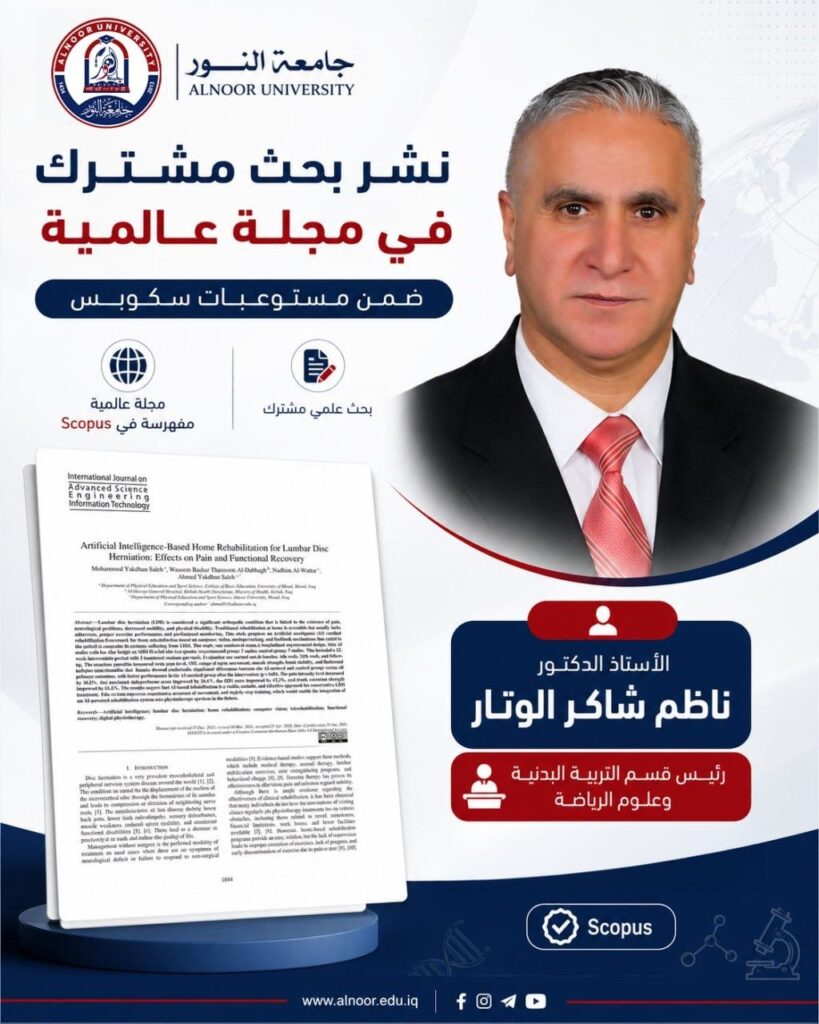
In a new scientific achievement that reflects Alnoor University’s distinguished research presence, Prof. Dr. Nazim Shakir Al-Wattar, Head of the Department of Physical Education and Sports Sciences at the College of Education, Alnoor University, has published a scientific research paper in collaboration with a research team comprising lecturer Mohammed Yaqdan Saleh from the Department of Physical Education and Sports Sciences, College of Basic Education, University of Mosul; Wasim Bashar Thanoon from Alhawija General Hospital, Kirkuk Health Directorate – Ministry of Health; and Ahmed Yaqdan. The research was published in the international journal IJASEIT, which is classified in the second quartile (Q2) and indexed in the Scopus database, under the title:
Artificial Intelligence-Based Home Rehabilitation for Lumbar Disc Herniation: Effects on Pain and Functional Recovery
The study addressed the design and implementation of an AI-supported home rehabilitation program for patients with lumbar disc herniation, based on motion tracking and the provision of real-time feedback, contributing to the improvement of therapeutic exercise performance.
The study included (14) participants who underwent the program for (12) weeks, at a rate of three sessions per week, with a comparison conducted between the outcomes of the AIbased smart program and the traditional home rehabilitation program. The results demonstrated the superiority of the artificial intelligence-based program in reducing pain levels, improving functional disability, increasing range of motion, and enhancing muscle strength and trunk stability among the participants in the experimental group.
The study confirmed that employing artificial intelligence technologies in home-based rehabilitation programs represents a promising direction for the advancement of healthcare services, by enhancing the accuracy of therapeutic exercise performance and increasing patients’ adherence to the rehabilitation program, thereby improving recovery prospects and achieving better therapeutic outcomes.
This scientific publication reflects Alnoor University’s commitment to supporting rigorous research and strengthening research collaboration with universities and healthcare institutions, contributing to the production of high-quality studies with scientific and practical impact at both the local and international levels.